

Family Law and the Winter Holidays: Parenting Schedules, Travel and Passports
By Adam Bukacel (Student-at-Law)
Holiday parenting schedules, international travel consent letters and passport exchanges — how Calgary families can plan ahead for the 2026–2027 winter break.
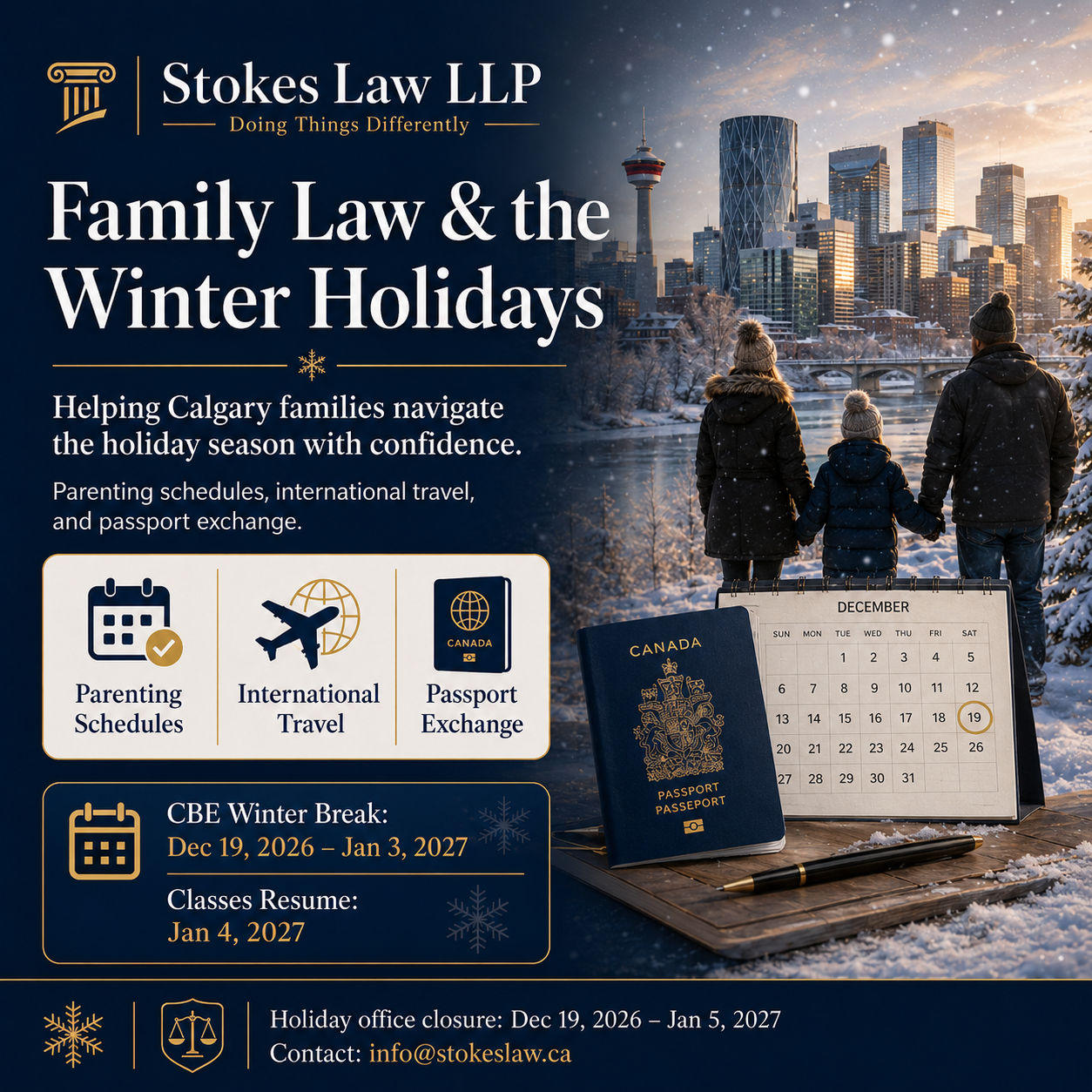
With the winter holidays approaching, families are preparing for school breaks, travel, celebrations and time with loved ones. For separated parents, however, the holiday season can also bring questions about parenting schedules, international travel, passports and last-minute changes.
At Stokes Law LLP, we understand that these issues can arise quickly. The good news is that many holiday parenting issues can be addressed with advance planning, clear communication and, where necessary, timely legal advice. Our team is available to help families prepare for the holidays so that legal uncertainty does not get in the way of the celebrations that matter.
Family Law and the Holidays
Family law and the holiday season often intersect. Some of the most common issues that can arise include:
- determining parenting time over Christmas and the winter school break;
- deciding where and when parenting exchanges will occur;
- accommodating family events and holiday traditions;
- international or out-of-province travel;
- obtaining consent for a child to travel;
- exchanging passports and other travel documents; and
- responding to unexpected changes in holiday plans.
The holidays have a way of arriving faster than expected. A parenting arrangement that works throughout the school year may not provide enough detail to deal with Christmas Eve, Christmas Day, New Year’s Eve, travel or an extended school break. A clear holiday plan can reduce uncertainty for both parents and, most importantly, for the children.
Calgary’s 2026–2027 Winter School Break
For families with children attending most Calgary Board of Education schools, the 2026–2027 instructional calendar provides:
- Last day of classes: Friday, December 18, 2026
- Winter Break: December 19, 2026 to January 3, 2027
- Classes resume: Monday, January 4, 2027
These dates are confirmed in the Calgary Board of Education’s 2026–2027 Instructional Calendar. Knowing the school calendar in advance provides parents with an opportunity to establish exactly when the children will be with each parent and to identify any travel or passport issues before they become urgent. Parents should also check the calendar for their child’s particular school, as individual school programming may affect scheduling.
What Should a Holiday Parenting Schedule Look Like?
There is no single parenting schedule that is appropriate for every family. The overriding consideration should be the children’s best interests rather than simply what is most convenient for either parent. A written holiday schedule can also reduce future disagreements by establishing clear expectations in advance.
Depending on the children’s ages, existing parenting arrangements, family traditions, travel plans and the parents’ ability to cooperate, several approaches may be considered.
Option 1: Divide the Winter Break in Half
One straightforward approach is to divide the school break approximately equally. For example, Parent A has the children from December 19, 2026 at 10:00 a.m. until December 27, 2026 at 10:00 a.m., and Parent B from December 27, 2026 at 10:00 a.m. until the children return to school on January 4, 2027.
The parents can alternate which parent receives the first portion of the break each year. This approach can work particularly well when both parents want extended, uninterrupted holiday time with the children.
Option 2: Alternate Christmas and New Year’s
Another approach is to divide the major holidays rather than simply dividing the break by days. For example, Parent A has the children from December 18 after school until December 26 at noon, and Parent B from December 26 at noon until the children return to school on January 4. The following year, the parents reverse the arrangement.
This allows one parent to have Christmas Eve and Christmas Day while the other has the latter portion of the holidays and New Year’s Eve.
Option 3: Split Christmas and Alternate the Remaining Break
Some families want the children to see both parents around Christmas. A possible arrangement might provide December 24 with Parent A and December 25, after a specified exchange time, with Parent B. The balance of the winter break can then be divided between the parents or follow the regular parenting schedule.
This structure can work for parents who live relatively close together, but multiple exchanges may not be appropriate for every child or every family.
Option 4: Continue the Regular Parenting Schedule With Holiday Exceptions
Some families prefer to preserve the children’s regular schedule as much as possible. The normal parenting rotation continues, but Christmas Eve, Christmas Day and New Year’s Eve are specifically addressed as exceptions. For example:
- Christmas Eve alternates annually;
- Christmas Day alternates annually;
- New Year’s Eve alternates annually; and
- all other days follow the normal parenting schedule.
This can reduce disruption, particularly where children are accustomed to a consistent parenting rotation.
Details Matter
A parenting schedule should ideally provide more than simply stating which parent has “Christmas.” Consider addressing:
- the exact date and time each parent’s parenting period begins and ends;
- where exchanges will take place;
- who is responsible for transportation;
- Christmas Eve, Christmas morning and Boxing Day;
- New Year’s Eve and New Year’s Day;
- extended-family celebrations;
- the children’s activities and commitments;
- domestic and international travel;
- telephone or video contact with the other parent while travelling;
- passports and other documents; and
- what happens if travel is delayed.
Clear exchange times can prevent disputes over whether “Christmas Day” means midnight, Christmas morning, noon or the entire calendar day. The Department of Justice Canada also notes that transitions may be easier for children when exchanges happen at natural points in their schedules, and that transportation and practical considerations should be addressed when establishing parenting arrangements.
International Travel During the Holidays
Winter break is also a popular time for families to travel internationally. If a child is travelling outside Canada without one or more parents or persons with decision-making responsibility, the Government of Canada recommends that the child carry a signed consent letter from the person or persons who are not travelling.
Importantly, a consent letter is not generally a legal requirement under Canadian law, but immigration authorities, airlines or Canadian officials may request one. Failure to provide satisfactory evidence of consent can result in delays and, in some circumstances, difficulty entering or leaving another country. Parents should therefore deal with travel documentation well before the departure date.
A consent letter will typically identify:
- the child or children travelling;
- the parents or other persons with decision-making responsibility;
- their contact information;
- the adult travelling with the child;
- that person’s relationship to the child;
- the destination;
- the dates of travel; and
- the duration of the trip.
The Government of Canada recommends carrying an original signed letter where possible. Although any adult may witness the signature, the federal government’s guidance strongly recommends having the consent letter witnessed by a notary public. Parents should also review the entry and exit requirements of the destination country, as individual countries may impose additional requirements for children travelling with only one parent.
What if the Other Parent Will Not Consent to Travel?
Travel disputes should not be left until the days immediately before departure. Existing parenting orders and agreements should first be reviewed carefully to determine what they say about travel, decision-making responsibility, notice requirements, passports and consent.
If the parents cannot agree, legal advice may be required to determine what options are available. Alberta parenting orders can contain specific parenting responsibilities and mechanisms for resolving future parenting disputes, and the appropriate terms will depend on the circumstances of the particular family.
Booking non-refundable travel before resolving a known dispute about consent can create additional pressure and expense. Where international travel is contemplated, dealing with the issue early provides substantially more time to resolve disagreements.
Passport Exchanges
Passports can become another source of holiday conflict. In many separated families, one parent retains the children’s passports between trips. If the other parent intends to travel, the passport will therefore need to be provided sufficiently far in advance.
A holiday agreement or parenting plan can address:
- who ordinarily holds the children’s passports;
- when passports must be provided before travel;
- where the exchange will occur;
- when passports must be returned after the trip;
- whether copies of travel itineraries must be provided;
- emergency contact information; and
- any other documents that must accompany the passports.
It may be useful to avoid scheduling the passport exchange for the evening before an international flight. Missing documents, illness, weather, flight changes or misunderstandings can quickly turn a holiday issue into an urgent legal problem. Advance planning provides everyone with room to resolve problems before they affect the trip.
How Can Stokes Law LLP Help?
Holiday parenting issues do not need to become holiday emergencies. Stokes Law LLP can assist with matters including:
- reviewing existing parenting orders and agreements;
- negotiating holiday parenting schedules;
- preparing parenting-time proposals;
- resolving disagreements regarding holiday parenting time;
- advising on international travel with children;
- preparing and notarizing travel consent letters;
- addressing passport exchanges; and
- helping families respond to unexpected parenting issues.
Our objective is practical: identify the problem, develop a workable solution and allow families to move forward.
Stokes Law LLP will be closed from December 19, 2026 through January 5, 2027. Families anticipating holiday parenting, travel or documentation issues are encouraged to contact our office well before the closure period. For more information about how our family law team can help, contact info@stokeslaw.ca.
Talk through your situation with our team
This article is general information about Alberta family law, not legal advice. Every family is different — book a free 30-minute consultation and we'll walk through how the law applies to you.
Book a free consultation →More blogs
Family Violence
Supreme Court of Canada Recognizes New Tort of Intimate Partner Violence: Ahluwalia v Ahluwalia
Privacy & Torts
Can I Sue Someone for Sharing Intimate Images Without My Consent? Alberta Court Awards $92,500
Property Division
Who Gets the Pet After Separation? Alberta Confirms It's Not About the "Best Interests of the Cat"